Buying guide / Pan sizing & liner fit
Commercial sheet pan
size guide.
Get the pan, rack and liner
working to the same dimensions.
A “full sheet” label is not enough to place an order. Start with the size system, measure the rim and flat base, then check the pan through your production line.
Find your pan size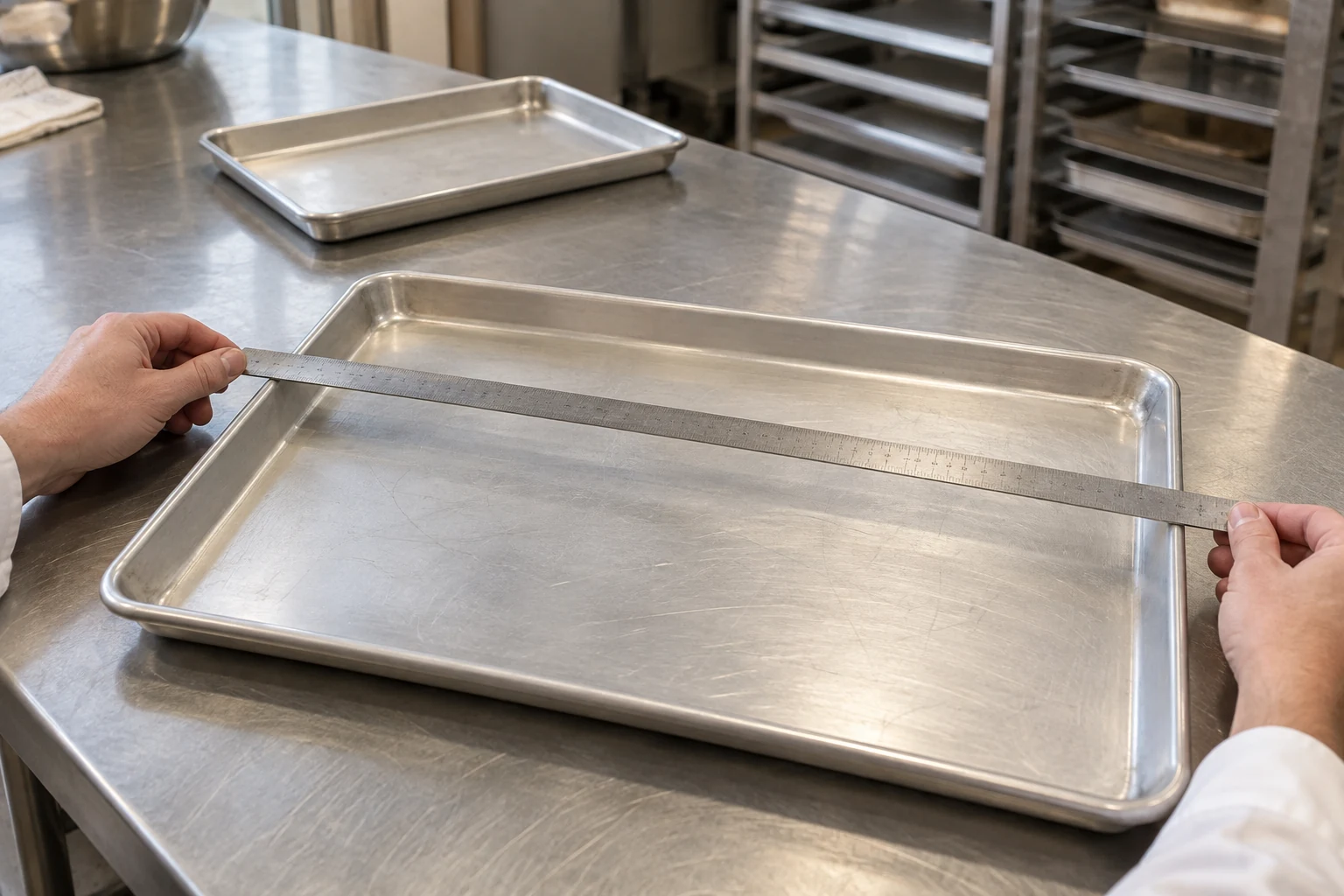
The dimensions to know
Full sheet: 26 × 18 in.
Half sheet: 18 × 13 in.
In the US size system, a full sheet pan is nominally 26 × 18 inches and a half sheet is 18 × 13 inches. A quarter sheet is commonly 13 × 9½ inches. These names describe the outside pan format, not the finished liner size.
A 600 × 400 mm bakery tray and a 530 × 325 mm GN 1/1 tray are separate formats. Choose the format your equipment accepts, then specify the actual pan and liner dimensions.
01 / Size reference
Commercial sheet pan size chart.
Use these common format names to identify the pan family. Keep the approved drawing as the purchase reference: rim design, manufacturing tolerances and actual outside dimensions vary by model.
| Pan format | Nominal size | Converted size | Where to check fit |
|---|---|---|---|
| US full sheet | 26 × 18 in | 660.4 × 457.2 mm | Full-size commercial sheet-pan ovens and racks. |
| US half sheet | 18 × 13 in | 457.2 × 330.2 mm | Smaller batches and equipment designed for this format. |
| US quarter sheet | 13 × 9½ in | 330.2 × 241.3 mm | Small runs, samples and portioned production. |
| US eighth sheet | 9½ × 6½ in | 241.3 × 165.1 mm | Very small batches and compact preparation stations. |
| Metric bakery tray | 600 × 400 mm | 23.62 × 15.75 in | Bakery equipment built around the 600 × 400 mm format. |
| Smaller metric tray | 400 × 300 mm | 15.75 × 11.81 in | Equipment specified for 400 × 300 mm trays. |
| GN 1/1 | 530 × 325 mm | 20.87 × 12.80 in | Gastronorm equipment; check the specific tray construction. |
US dimensions are common nominal references. Metric equivalents use 1 inch = 25.4 mm; extra decimal places describe the conversion, not the pan’s manufacturing precision. Length and width may appear in the opposite order in a catalog.
02 / Three size systems
“Full size” changes with the equipment.
26 × 18 in
Full, half and quarter sheet names belong to a common US sheet-pan family. A half sheet has roughly half the nominal footprint of a full sheet, with a different orientation.
600 × 400 mm
A common bakery tray format for ovens, proofers and trolleys. The smaller 400 × 300 mm format is its own equipment choice. Neither name confirms a liner’s flat-fit dimensions.
530 × 325 mm
GN 1/1 belongs to a foodservice container system. A baking tray and a deep food pan can share the GN footprint while differing in height, rim shape and usable base.
Specify “US full sheet, nominal 26 × 18 in” or “bakery tray, 600 × 400 mm.” For an existing line, add the equipment model and pan drawing. Avoid “full-size tray” on its own.
This distinction matters for liners too. A mat sold as “full sheet” in a metric range can be 400 × 600 mm; it is not automatically sized for a US full sheet. Buy against the finished millimeter dimensions and the pan’s flat base.
03 / Pan measurements
Measure three things.
Keep them separate.
Use a clean, cool, undamaged pan on a flat bench. Use a rigid rule for the footprint and base; use calipers or a height gauge where the drawing needs closer control. Record every dimension in millimeters and mark the measurement points on a sketch.
Outside length × outside width
Measure the widest points across the rim, including projecting lips or handles. These dimensions govern entry into the oven and engagement with rack rails. Measure each direction in more than one place to catch a distorted rim.
Flat base length × flat base width
Measure where a liner actually lies, before the base curves up into the walls. The top opening is larger on a sloped-sided pan. Record the flat-base corner shape and radius as well: a square-cut liner can lift at a rounded corner even when its length and width fit.
Overall height & rim profile
Measure from the supporting surface to the top of the rim. Show rolled beads, handles and rail contact points in a side view. For nesting, record the stack height of a stated number of pans; pan height alone does not give the packed stack height.
Measure several representative pans when replacing liners for an existing fleet. Separate bent or worn pans from the reference set. For repeat purchasing, agree tolerances on the drawing rather than choosing a liner around one damaged tray.
04 / Equipment fit
Follow the pan through the whole line.
Start with the equipment’s specified tray format. Then verify the actual sample. A plan-view footprint cannot describe support, stops, loading direction or clearance above the product.
Oven opening & chamber
Check the loading opening, usable chamber depth and the clearance specified by the oven maker. Include door hardware, fan guards and probes. A tray that enters the door can still obstruct airflow.
Rack rails & support
Record the distance between supports and the rim profile they carry. Confirm the insertion direction, bearing on both rails and any rear stops. A narrower tray can pass through the opening yet have too little support.
Vertical clearance
Add pan height, liner or mold height and the product’s maximum rise. Check the usable space between loaded levels. The number of rail positions is not the number of usable baking levels for every product.
The rest of the route
Check proofers, blast chillers, cooling racks, washing stations and storage. Use the same approved pan through the entire route, including a loaded trolley with its stops or restraints engaged.
Do not subtract a universal allowance from the oven chamber and call it a pan specification. Confirm the operating clearance with the equipment instructions, then test loading, full support and door closure with the intended sample.
05 / Finished liner size
Size the liner to the base,
not the catalog pan name.
A liner must sit flat through loading and baking. Length, width, corner shape and finished edges all matter. The fit also needs enough room for the bakery’s removal and washing routine.
A worked sizing example
Flat base: 560 × 360 mm
Clearance: 3 mm on each edge
Finished liner: 554 × 354 mm
Subtract twice the edge clearance from each base dimension: 560 − 6 and 360 − 6. This is an illustrative measured base and chosen clearance, not a standard cut size for a 600 × 400 mm pan. Approve the corner shape and finished sample separately.
| Liner | Dimension brief | Edge & fit check |
|---|---|---|
| Reinforced silicone mat | Finished length, width, thickness and corner shape, including the border. | Order the final factory-finished size. Do not trim a fiberglass-reinforced mat. |
| PTFE-coated sheet | Cut-sheet dimensions, thickness and edge condition; roll width if supplied as a roll. | Use factory-cut sheets or a grade approved for cutting. Inspect for fraying and exposed reinforcement. |
| Parchment paper | Finished sheet size and shape, pack count and any intentional overhang. | Approve flat placement and loading. Keep loose edges away from heating elements and follow oven placement requirements. |
| Open mesh liner | Finished dimensions, opening pattern and border width. | Evaluate with the intended perforated tray; a solid liner covers the ventilation openings. |
A 420 × 295 mm half-sheet liner illustrates why the mat is smaller than the nominal pan footprint. Our full-sheet mat range includes metric bakery formats. Treat these as finished product dimensions and compare them with your measured base before selecting a sample.
Compare the surfaces after fit is settled: PTFE vs silicone → or parchment sheets, rolls & pre-cut liners →
06 / Production decisions
Usable area decides the layout.
Construction decides the trial.
A larger outside footprint does not give the same increase in saleable output. Base area, corner radii, spread, spacing and oven loading determine how many pieces a tray can carry.
Calculate the product layout on the flat base.
For a simple rectangular grid, count the positions in each direction using the finished product footprint, the gap between pieces and the margin at the pan edge. Include any border on a printed liner. Recheck the plan with the actual bake, especially for products that spread.
On an illustrative 560 × 360 mm flat base, 60 mm finished cookies with a 20 mm gap and a 10 mm edge margin fit a starting grid of 7 × 4. Seven cookies occupy 7 × 60 + 6 × 20 + 2 × 10 = 560 mm; four rows occupy 4 × 60 + 3 × 20 + 2 × 10 = 320 mm.
This is a layout calculation, not a promised batch yield. Confirm actual spread, handling space and baking uniformity.Keep material and geometry in the comparison.
Compare actual metal thickness in millimeters rather than a gauge number without its material convention. Record the metal, finish, rim reinforcement and pan weight. Aluminum, coated steel and stainless steel pans of the same outside size can differ in handling, heat response, cleaning requirements and flatness under load.
For perforated pans, specify hole diameter, pitch and open area. For coated pans, identify the coating and permitted cleaning routine. Check the combination of pan and liner in production: adding a solid mat to a perforated tray changes the underside airflow.
Order enough pans for the rotation.
Count pans in baking, proofing, cooling, washing and preparation, plus the clean reserve needed for the next load. Keep pan formats identifiable at each station. In a mixed fleet, separate size codes prevent the wrong tray or liner reaching a rack.
07 / Sample approval
Approve fit before the repeat order.
Check the cold dimensions.
Compare the sample with the drawing: outside footprint, flat base, corners, height, thickness and agreed tolerances. Place the intended liner inside and check for curling, buckling and border interference.
Check the loaded route.
Use a representative production load. Confirm rail support, insertion, stops and vertical space in each piece of equipment. Test the intended orientation; turning a pan changes which rim the rails support.
Run the normal bake and wash.
Record release, underside color, saleable pieces and handling. Check flatness after the tray has cooled, inspect the rim and surface, and repeat the normal cleaning cycle. Separate oven-position effects from pan or liner differences.
Keep the approved reference.
Retain the sample, drawing revision, liner specification and trial record. Set measurable acceptance criteria for dimensions and flatness under stated conditions, plus visible defects and packing. Use the same references for incoming inspection.
08 / Common questions
Sheet pan sizing, answered.
What size is a commercial full sheet pan?
The common US full sheet pan is nominally 26 × 18 inches, equivalent to 660.4 × 457.2 mm. These are outside size references. The flat baking area is smaller, and the actual manufactured dimensions come from the pan drawing.
What are half sheet and quarter sheet pan dimensions?
A common US half sheet pan is nominally 18 × 13 inches (457.2 × 330.2 mm). A quarter sheet is nominally 13 × 9½ inches (330.2 × 241.3 mm). Check the actual outside dimensions and flat interior before ordering equipment or liners.
Is a 600 × 400 mm tray the same as a US full sheet?
No. A 600 × 400 mm bakery tray is shorter and narrower than the nominal 660.4 × 457.2 mm US full sheet. The two formats need their own oven and rack compatibility checks.
Is GN 1/1 the same as a 600 × 400 mm bakery tray?
No. GN 1/1 is 530 × 325 mm; the bakery format is 600 × 400 mm. The outside dimensions, rail support and usable area differ. Use the equipment’s specified format rather than the phrase full size.
Are sheet pans measured inside or outside?
Catalog sheet pan dimensions generally refer to the outside footprint. Measure outside the rim for equipment fit, and measure the flat interior base separately for liners and product layout. Specify which measurement each number represents.
What size silicone mat fits a half sheet pan?
A 420 × 295 mm mat is one commonly offered half-sheet liner format, but the correct size depends on the pan’s flat interior, corners and required clearance. Compare the finished mat drawing with the actual pan and approve a full-size sample.
Can I cut a silicone baking mat to fit?
Do not cut a fiberglass-reinforced silicone mat. Cutting breaks its finished edge and can expose the reinforcement. Order the finished size and corner shape you need. Parchment and selected PTFE sheet grades have different cutting requirements.
Will a full sheet pan fit my oven?
A US full sheet needs equipment that accepts its actual outside footprint and provides the required operating clearance. Check the oven model, chamber, opening and rails. Most domestic ovens do not accept a US full sheet; measure before purchasing any smaller format as well.
From measurements to a quotation
Send a pan drawing.
Get a defined liner brief.
BakewareLink can review your tray measurements for silicone mats, PTFE sheets, parchment and related baking supplies. Send the dimensions in millimeters with a top view and side view so the fit can be evaluated before sampling.
- Pan format, outside length × width and overall height
- Flat base length × width and corner radius
- Oven / rack model, insertion direction and support details
- Required liner construction, finished size and edge clearance
- Baking conditions, cleaning routine and sample quantity
- Order volume, destination market and packaging requirements